|
|
|
Democratic government both assumes and requires extensive participation by citizens in the functioning of government.
Interpreting the error rate:
|
THE POLITICAL NATURE OF THE MASSES
Democratic government both assumes and requires extensive participation by citizens in the functioning of government.
- The extent and nature of participation depends some on the model of democracy.
- The majoritarian model puts more emphasis on mass participation.
- The pluralist model emphasizes participation by intense minorities, those who are vitally interested in the policy options at stake.
- To judge how well either model operates, we need to know what opinions are held by the public generally and specifically by groups within the public.
- The best way to acquire this information is through survey research, or public opinion polls.
- The basics of the theory behind a sample survey.
- One does not need to examine every case in a population to draw some conclusions about that population.
- One can draw inferences (estimates) about the population's characteristics from studying a sample of its cases.
- The more cases in the sample one studies, the more accurate the inferences.
- Moreover, if the sample of cases studied were drawn in a random fashion--one could compute the likely margin of error in the estimates or inferences.
- The key feature of a random sample is that there is a known probably attached to the likelihood of each case appearing in the sample.
- In a simple random sample, each case has an equal probability of occurrence.
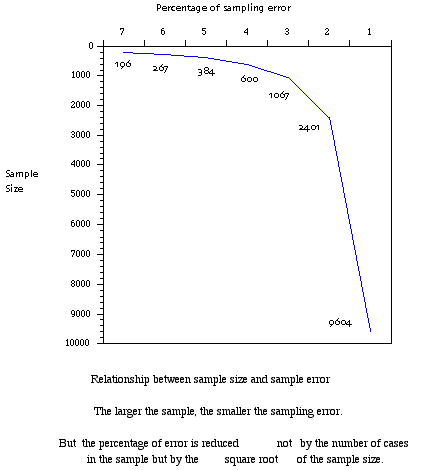
- For random samples of specified sizes, here are the likely error rates--you are 95% sure that your estimate will be within the range of error:
- 200 cases7% error -- (196 cases, in truth)
- 600 cases 4% -- (600)
- 1,000 cases3% -- (1,067)
- 2,500 cases2% --(2,401)
- The percentage of error in the inference is called the sampling error, and it distributes so:
Interpreting the error rate:
- Let's assume a sample size of 1,067 stating that 46% of the population approve of the job that Bush is doing as president:
- This is called a point estimate
- A sample that size has a 3% error rate, so we anticipate that the point esimate is not exactly right.
- So we can be 95% confident that the true estimate lies within 43% and 49%
- This is called the internal estimate at the 95% confidence interval
- Implications of this relationship:
- Most national samples have about 1,000 cases, which produces error rates of 3% about the point estimates reported
- Note that sampling error is dependent on the sample size, and not on the size of the population being sampled.
- To be accurate within 3%, you need a sample size of 1,067- regardless of whether you are sampling in the nation or in the smallest state.
- Therefore, it costs as much to draw a sample in a state as in a nation.
- We usually have better poll data for the nation than for any state.
- There are many other errors in making inferences from survey research
- Poorly worded questions
- Lack of correspondence between the date of the survey and the prediction
- Poor analysis of the data
The survey data available for our usage:
- 1990-91 World Values Survey--described in Dalton on pp. 289-290.
- Carried out in 42 nations with support from research foundations and national governments.
- Dalton based his book on survey data from only five countries:
- United States N= 1,839
- Britain N= 1,484
- West Germany N= 2,101
- France N= 1,002
- East Germany N= 1,336
How do people get their opinions
- People acquire their values through political socialization, the complex process through which individuals become aware of politics, learn political facts, and form political values.
- There are various agents of socialization:
- Family
- School
- Community
- Peers
- Media
- There are two operating principles that characterize early learning:
- The primacy principle: What is learned first is learned best
- The structuring principle: What is learned first structures later learning.
- Learning in the family utilizes both of these principles.
- Consider the example of religion.
- This is acquired through the family.
- Similarly, parental influences can also be seen in your party identifications.